
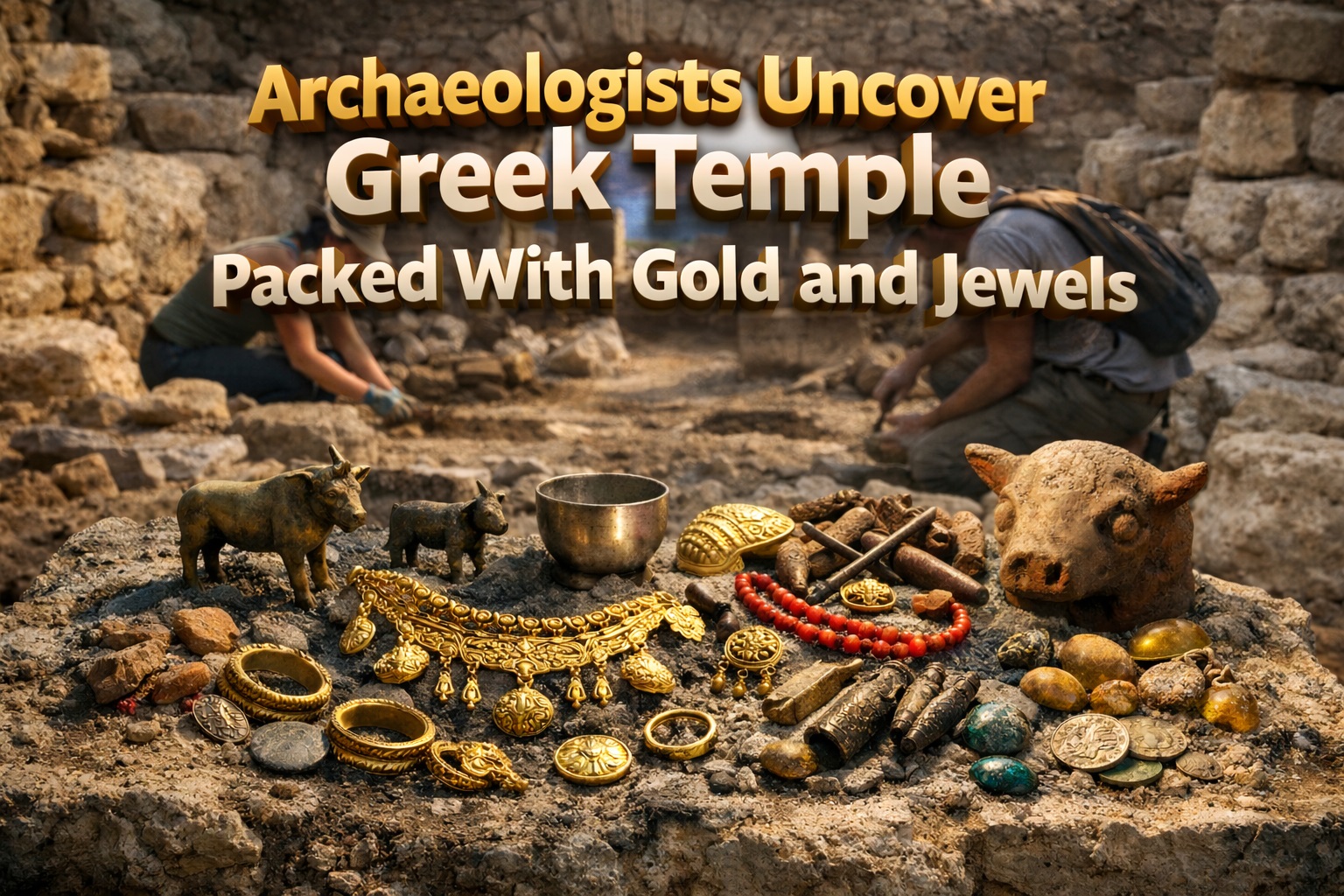
The discoveries kept piling up for a team of 50 archaeologists working on the Greek island of Evia—but the most striking find was the identification of 2,700-year-old altars laden with precious jewelry and ritual objects.
Near the ancient Sanctuary of Amarysia Artemis on Greece’s second-largest island, researchers uncovered a previously unknown temple dating to the 7th century BC. According to a translated statement from Greece’s Ministry of Culture, the structure contained heavily used altars, pointing to long-standing ritual activity at the site.
Measuring roughly 100 feet in length—a scale characteristic of temples from this period in ancient Greece—the building was fully revealed in 2023. It preserves exterior walls and an arch on its western side. Even more compelling, archaeologists reported a “significant number of structures” within the temple, including multiple hearths believed to have served as altars.
Among them, a horseshoe-shaped altar stood out as particularly unusual. Thick layers of ash filled with charred animal bones indicate sustained ceremonial use. Researchers noted that some of these altars may even predate the temple itself, with pottery from the earliest phase of the horseshoe altar dating to the late 8th century BC.
The discoveries extended far beyond architectural remains. Excavators recovered Corinthian alabaster vessels, Attic pottery, and locally produced ritual jugs. They also unearthed an array of valuables, including gold, silver, coral, and amber jewelry, along with Eastern amulets and bronze and iron fittings.
Constructed from rough bricks set on a dry-stone foundation, the temple reflects the swampy conditions of the area at the time it was built. Pillars lining the interior walls once supported a tiled roof. Evidence suggests that a fire damaged part of the structure, prompting the addition of brick partitions to protect what remained and the creation of a new section toward the end of the 6th century BC.
In what are believed to be the temple’s earliest layers, archaeologists found Geometric-period bronze figurines depicting bulls and a ram, as well as a clay bull’s head dating back to the Mycenaean era.
The site’s history stretches even further back. Test trenches revealed traces of buildings from the 9th century BC, indicating that the area was in use well before the temple was constructed. Preliminary findings suggest the cult practiced there emerged in the centuries following the collapse of Mycenaean civilization.
Additional excavations on the surrounding hill uncovered massive Early Copper Age walls, which the Ministry of Culture described as part of a prehistoric fortification system.
As researchers continue to explore the deeper layers of the landscape—many offering glimpses into daily life beyond the sacred space—the evolving prominence of the temple remains a source of fascination, even as its trove of gold and jewels has already come to light.
Source: Popularmechanics Edited By Bernie